

Keywords are the foundation of advertising campaigns in Google Ads. They determine whether your ads will be shown to potential customers. Effectively selected keywords help you reach the right audience, increasing your chances of achieving your advertising goals. However, it is important to first understand what keywords are and how to search for them.
What are keywords?
Definition
Keywords are expressions or single words that users type into the Google search engine in order to find specific information. In the context of Google Ads, these are terms that are closely related to your product or service. For example, if you run a sports footwear store, suitable keywords might include “running shoes,” “best sneakers,” “sports footwear.”
Why are keywords important?
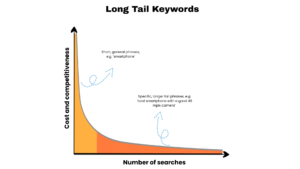
Searching on Google is a scenario where users are actively looking for products or solutions. By choosing the right keywords, you can reach people who are interested in what you offer and direct their attention to your offer. This increases the chance of conversion. Additionally, they enable you to precisely target a specific audience, which affects the effectiveness of your campaign and minimizes wasted advertising budget. It is also worth mentioning that many who run their own Google Ads campaigns insist on using generic keywords, thereby neglecting long-tail keywords. Paradoxically, long-tail phrases can be more effective and yield better results than those that first come to mind when thinking about a given product or service. Below we explain exactly what long-tail keywords are:
Long tail keywords – longer and more detailed keyword phrases that users enter into a search engine to find more precise results. Unlike short and more general keywords, long tail keywords consist of several or more words. For example, instead of using the keyword “smartphone,” you could use a long tail keyword such as “best smartphone with a good 48 Mpix camera.”
Types of keywords
- Generic keywords:
These are popular and widely used terms, e.g., “coffee” or “sweater.”
Competition for generic keywords is usually high. - Long tail keywords:
These consist of longer and more detailed phrases, e.g., “best coffee spot in Toruń.”
They have lower competition but bring in more targeted traffic. - Informational keywords:
These can attract users who are looking for tips, advice, or instructions, e.g., “how to run a campaign.” - Transactional keywords:
Related to purchase intent, e.g., “buy coffee online” or “cosmetics promotion.”
They often attract customers who are ready to make a purchase. - Branded keywords:
Branded phrases are keywords or expressions directly related to your brand or product. These are the terms potential customers type into Google when looking for specific information about your company or products. Examples of branded phrases may include the brand name, product or service names, and other associations with your company.
Branded phrases are a specific type of keyword, so it is worth paying special attention to them.
Why should you use branded phrases?
- Increasing brand recognition
Using branded phrases increases brand awareness among internet users. When customers see your ads in search results, they begin to associate your brand with specific products or services. - Market competitiveness
Using branded phrases in Google Ads campaigns allows you to secure your position in search results. This makes it more difficult for competitors to gain positions in organic results or competitive ads. - Increasing the Click Through Rate (CTR)
Ads containing branded phrases often have a higher click-through rate than generic ads. Why? Customers who are already familiar with your brand or products are more likely to click on an ad containing branded phrases because it is more recognizable and credible to them. - Driving traffic to your website
Branded phrases are an excellent tool for directing users to your website. When someone types your brand name into a search engine, they are likely already interested in your products or services. Use this to guide them to a site where they can find more information or make a purchase. - Increasing conversions
Branded phrases are a valuable tool for boosting conversion rates. People searching for your brand or products already have some interest, which means they are more likely to make a purchase. Therefore, ads utilizing branded phrases can generate a higher conversion rate. - Protecting your brand
By using branded phrases in Google Ads campaigns, you control what information appears on the first pages of search results. This helps prevent situations where competitors use your brand in their ads, which could negatively impact your reputation.
How to use branded phrases in Google Ads campaigns?
- Select the appropriate phrases
Ensure that you choose branded phrases that are truly related to your brand and products. Avoid generic keywords that may be confusing or imprecise. - Consider different variants of branded phrases
Do not limit yourself only to the main brand names. Consider various versions of branded phrases, such as abbreviations, aliases, or popular terms that customers might use to find your company. This way, you won’t miss any opportunity to reach potential customers. - Monitor the competition
Regularly check whether competitors are trying to use your branded phrases in their campaigns. If so, you may need to adjust your strategy to maintain control over your brand or, if warranted, take appropriate legal action.Is someone stealing your company’s identity in their advertising campaigns?
Google suggests what to do in such a situation.
- Create personalized ads
For branded phrases, it is worth preparing personalized ads. Emphasize the unique features of your brand, the products or services offered, and the benefits for customers. - Monitor the results
Regularly track the performance of your campaigns using branded phrases. Check how much traffic they generate, their cost, and what conversions they bring. This will allow you to adjust your strategy based on actual results. - Use branded phrases with caution
Remember that branded phrases are important, but they should not dominate your campaigns. You must also include generic keywords that attract new customers.
Keyword match types
By match type
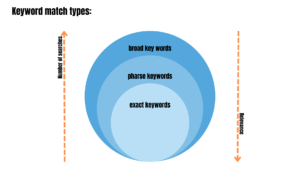
- Exact match (ang. exact):
The keyword matches the search phrase exactly. For example, for the keyword “natural cosmetics,” the ads will only be displayed when someone types that exact phrase. - Phrase match (ang. phrase):
The keyword matches the search phrase in a specific order, but may include additional words before or after it. For example, for the keyword “healthy food,” ads might be displayed for phrases such as “healthy food for kids” or “recipes for healthy food.” - Broad match (ang. broad):
The keyword is matched to various variants of the search phrase, including synonyms and related terms. This is a more flexible matching type that can bring in more traffic, but may also be less precise.
Negative keywords
Negative keywords are terms that inform the advertising platform that your ad should not be displayed in search results containing those specific words or phrases. This works by excluding your ad from certain queries or categories of keywords. For example, if you sell only new cars, it is advisable to set “used” as a negative keyword. This will prevent your ad from being displayed to people who are interested in used cars.
Why use negative keywords?
- Budget savings: By using negative keywords, you can avoid showing ads for irrelevant user queries. This helps save budget that might otherwise be wasted on unnecessary clicks.
- Improved traffic quality: By excluding keywords that attract the wrong users, you gain more targeted and valuable traffic to your website.
- Increased Click-Through Rate (CTR): Better matching of ads to user queries can lead to a higher CTR, which positively impacts ad positions and campaign quality.
How to use negative keywords?
Now that you understand the importance of negative keywords, here are a few tips on how to use them in your advertising campaigns:
- Data analysis: Regularly analyze data from your advertising campaigns by reviewing the search terms used by users to identify keywords that generate irrelevant traffic or do not lead to conversions. These keywords can become potential candidates for exclusion.
- Exclusion methods:
- Excluding based on search queries:
You can exclude keywords from within Google Ads based on previous user searches. Exclusions can be applied to all campaigns, just one, or even a specific ad group. - Excluding based on your own ideas:
Excluding based on user search queries means that the data is only available after the ad has already been shown for that phrase. This, in turn, means that you have already spent money on a search you did not want to advertise for. To prevent this, you can add your own exclusion ideas before they are actually searched for, anticipating potential user queries.
- Excluding based on search queries:
- Monitoring and adjustment: Advertising campaigns are dynamic. Regularly monitor the results and adjust the negative keywords based on market changes and user needs.
How to find the right keywords?
There are many ways to find the right keywords for your campaigns. Here are a few:
- Brainstorming: Start by creating a list of words and phrases related to your business. Consider what terms potential customers might type into a search engine to find your product or service.
- Dedicated tools: Use tools such as the Google Keyword Planner, Senuto or Ahrefs. Enter your keyword ideas and see what suggestions the tool generates. It will also show estimated search volumes and keyword competitiveness.
- Competitor analysis: Review competitor websites and see which keywords are used in their content. This can provide valuable clues regarding phrases that may attract potential customers.
- Google suggestions: As you start typing phrases into Google, you will notice autocomplete suggestions. These are popular queries that users frequently type. They can serve as valuable inspiration when selecting keywords for your campaign.
- Long tail keywords: In addition to popular phrases, it is also worth focusing on long tail keywords. These are more detailed and less competitive terms that can attract users who are more interested and ready to buy.

Google Ads campaigns – what are they and what are the rules?
If you are not sure whether your keywords are properly selected or you do not know how to research them – trust the specialists. As WP Care, we hold the status of an official Google Partner, which guarantees the high quality of our services. We can configure your campaigns or audit those you are already running.
Contact us, and we will definitely help you!
Check out our offer